
What Crenshaw County Deed Records Document
A deed names the parties, describes the land, and states the words of conveyance. It also carries execution and recording details. Crenshaw Probate records mortgages, plats, liens, easements, assignments, and releases beside the deeds. Each instrument type answers a different question. Match the document to what you want to learn.
| Deed Type | What It Does | Common Use |
|---|---|---|
| Warranty deed | Conveys the stated estate with warranties written into the instrument. | An ordinary sale with warranty language. |
| Quitclaim deed | Conveys whatever interest the grantor may hold without promising its extent. | Family transfers or correction of a possible interest. |
| Executor deed | Conveys property under estate authority recited in the instrument. | A probate-related sale or distribution. |
| Foreclosure deed | Records a transfer following authority and procedure stated in the deed. | Researching a mortgage-default transfer. |
| Tax deed | Documents a tax-sale-related conveyance subject to governing procedure. | Following sale and redemption history. |
A mortgage or lien works differently from a deed. It is an encumbrance, not a conveyance of title. Track any assignments and releases too, since they can change who holds the obligation or whether it still stands.
Enter the Crenshaw Probate Record Route
The Crenshaw Online Services page lists land-record lookup, probate-case lookup, a recording-account login, sign-up steps, and search instructions. The buttons work only inside a live session. Coverage dates, image prices, and certification options are best confirmed with Probate. The connected INGRecords service runs a county-selection and document-purchase model under local authorization. Ask Probate about Crenshaw coverage, image quality, account needs, price, and certified copies before relying on it. The county's own entrance page displays these access choices.
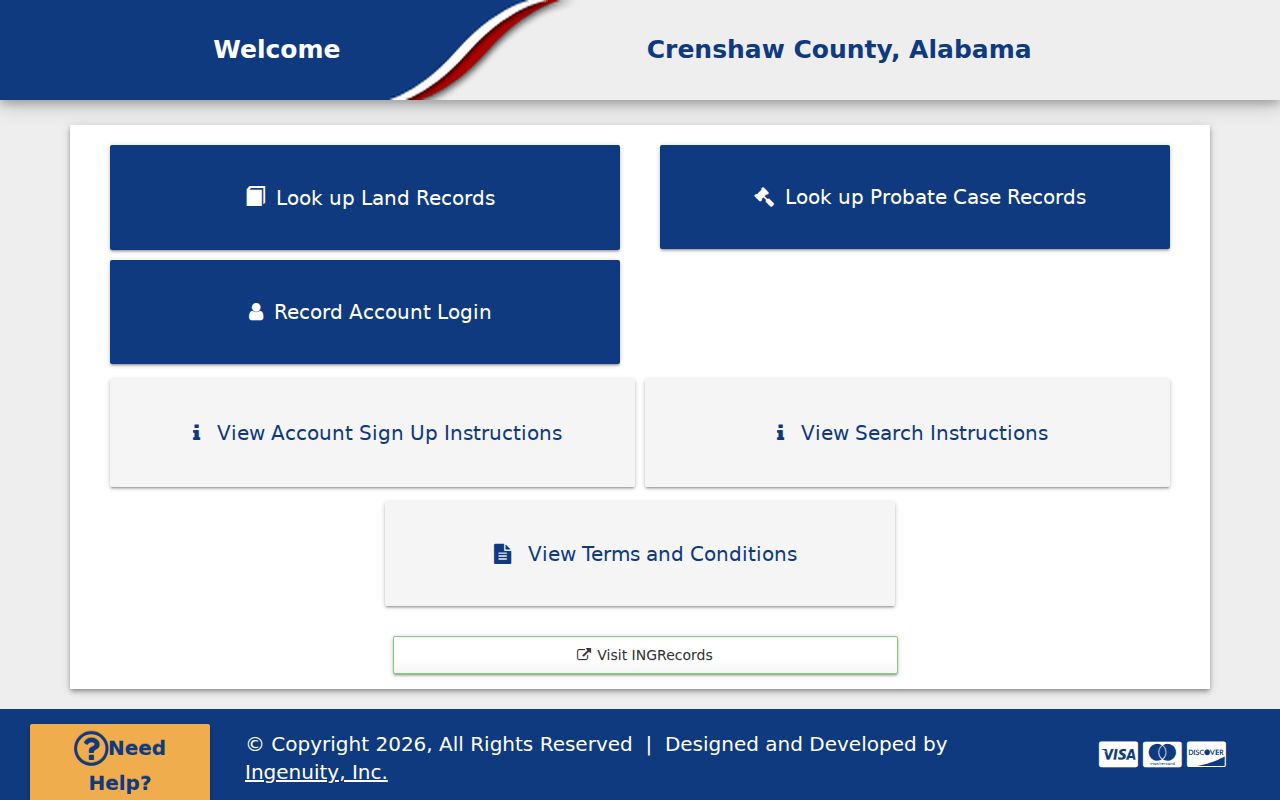
Together these options form an online access path. The Probate Office still decides what the index and the copies actually contain.
Prepare the Crenshaw Deed Search
Gather more identifiers than any search form will demand. That means every grantor and grantee name variant, the parcel number, a full legal-description fragment, and a likely transfer date. Add the document type and any book/page or instrument reference you hold.
| Clue | Purpose | Source |
|---|---|---|
| Party variants | Find initials, spouses, estates, trusts, and entities. | Deed, tax account, or probate file |
| Legal description | Separate same-name parties and changed addresses. | Tax record, plat, or earlier deed |
| Date range | Narrow a transfer, mortgage, assignment, or release. | Closing file, tax history, or court docket |
| Recording reference | Retrieve a specific instrument. | Index, deed recital, or court exhibit |
Note: Probate publishes no post-1950 index start year, so do not guess an online cutoff.
Follow Crenshaw Grantors and Grantees
Start the chain from a solid recent instrument. Then work backward through the parties named in each conveyance, keeping the legal description and recording reference aligned at every step.
- Find the latest deed and verify that its legal description matches the tract.
- Record the grantee, grantor, deed type, dates, and recording reference.
- Search the grantor as a prior grantee to locate that party's acquisition deed.
- Repeat while checking mortgages, releases, probate transfers, plats, easements, and court matters.
- When online access ends, request the corresponding index and deed book.
Index vocabulary
- Grantor
- The party conveying an interest.
- Grantee
- The party receiving the stated interest.
- Chain of title
- The connected sequence of instruments affecting the same land.
- Book/page
- A volume-and-page retrieval reference.
- Instrument number
- A document identifier assigned where that indexing system is used.
Search Alabama Land Records Through 1950
The Secretary of State land collection covers statehood through 1950 and sends later inquiries to county probate offices. Search it by name, by township/range/section, or by book. It supplements local Crenshaw deed records rather than replacing them. The state interface lays out these search paths plainly.
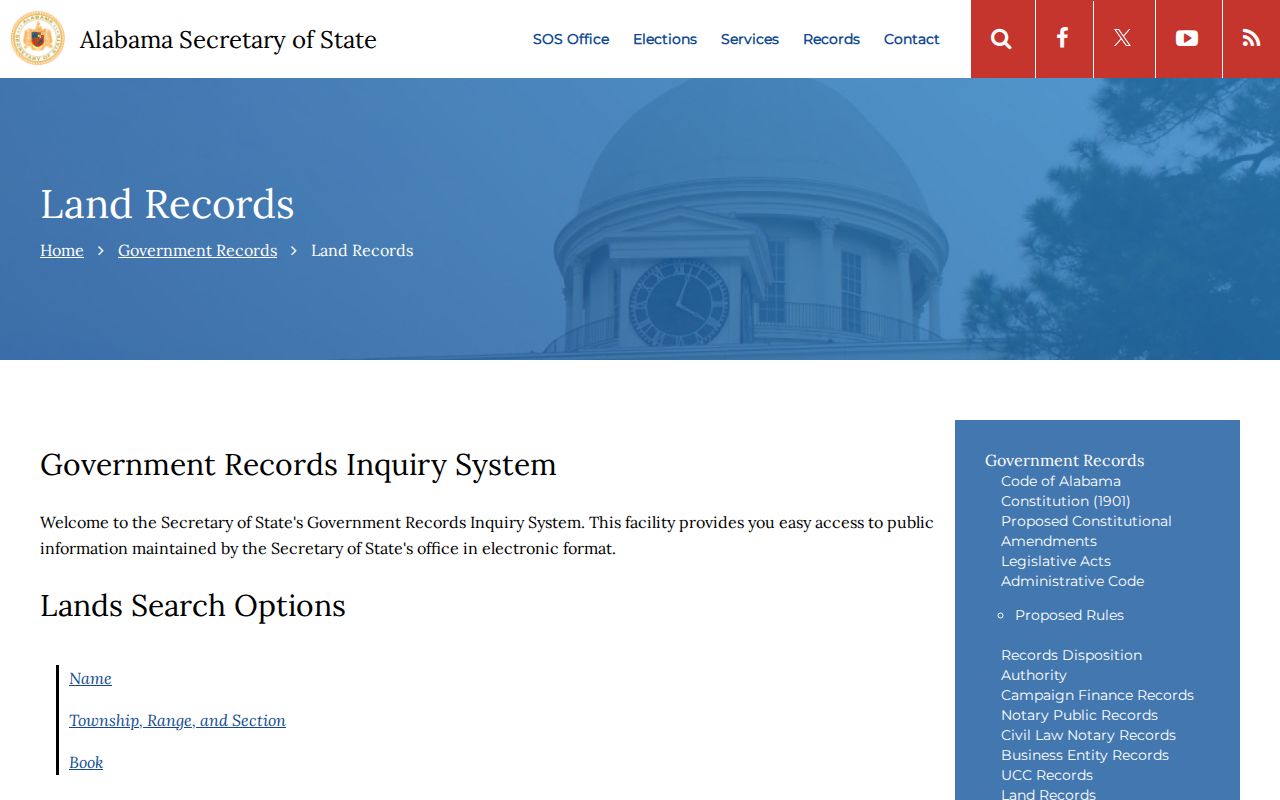
Bring the township, range, section, and book details straight from the deed.
Research Around the 1898 Courthouse Fire
An ADAH fire record places a Crenshaw courthouse fire in 1898. It does not prove any particular volume burned. It does make duplicate sources essential. Crenshaw formed in 1866 from parts of Butler, Coffee, Covington, Pike, and Lowndes counties. So an earlier tract may sit in a parent county chosen by date and geography. Use ADAH county microfilm. Also consult the FamilySearch catalog of Crenshaw probate material from about 1870 to 1930, and the 1936 WPA township map with its owner lists. The map is a locator only, not current title or survey evidence.
Use Every Crenshaw Deed Access Channel
Online access is convenient, but it is not the only route. At the courthouse, ask the recording desk. Request a search by name, legal description, document type, and date range. By phone, confirm the right index, current coverage, copy options, and fees before sending payment. Keep a mail request narrow enough that staff can identify the instrument without guessing. Each channel reaches the same recorded land record.
For older work, try the Alabama Department of Archives and History. It offers county microfilm descriptions and fee-based research. Its published research service charges $15 for an Alabama resident. Out-of-state requesters pay $25. The fee covers up to 20 pages. Each additional page costs 25 cents. The estimate runs two to three weeks. Confirm the Crenshaw series you need is available before ordering. FamilySearch affiliate access in the ADAH research room may help with cataloged film. Image restrictions and index completeness vary.
The Luverne Public Library serves as a local-history referral. Its official page claims no deed or genealogy collection. For a missing modern record, ask Probate directly. Do not assume an archive or library holds current recording-office material.
Audit a Crenshaw Chain Before Relying on It
Start with a simple ledger. Give every instrument its own row: recording date, execution date, grantor, grantee, deed type, legal description, stated consideration, and the book/page or instrument number. Then widen the sheet. Mortgages, assignments, releases, easements, plats, and probate references each get their own columns. The discipline pays off fast. It exposes skipped generations, name changes, and partial-interest transfers. It also flags legal descriptions covering only part of the expected land.
Treat the current tax parcel as a locator and nothing more. The tax owner may simply be whoever receives the bill, or a life-estate entry, an estate, or a name lagging behind a recent deed. A sample Crenshaw tax result showed life-estate notation and exemption clues. Neither proves what estate the deed created. Only the recorded language does that, so read it.
Conflicts happen. When two sources disagree, trust the primary instrument for what it says, then ask the custodian about indexing or update timing. Keep screenshots, request dates, searched name variants, and negative results. A "no hit" means little on its own. It only carries weight when the portal, coverage, criteria, and outage status are documented alongside it.
Obtain a Crenshaw County Deed Copy
For a deed copy, contact the Judge of Probate at the Crenshaw County Courthouse, 29 S Glenwood Avenue, Luverne, Alabama 36049, or call 334-335-6568. Have your details ready. Supply the names, document type, approximate date, reference number, and legal description. Ask specifically for inspection, an electronic image, a plain copy, or a certified copy.
Official Crenshaw copy and certification fees were not published for lookup here. Request a quote before paying. Record the office, product, fee, delivery method, and certification status for your file. A focused request can also cite Alabama Code §36-12-40, keeping statutory exceptions and local procedures in mind.
Recorded, not guaranteed. Crenshaw County deed records show instruments accepted for recording. They do not resolve every defect, unrecorded interest, indexing error, or legal question and are not a title opinion.