
Trace Back Crenshaw County Former Property Owners
Work from the newest recorded deed backward. Every deed names the prior owner as grantor, and that name becomes your next search. Crenshaw County land changed hands in small steps, so the chain builds one transfer at a time.
Never link two transfers on a shared name alone. Match the land description too. When the parcel description lines up, the chain holds.
| Transfer date | Grantor to grantee | Deed type | Book/page |
|---|---|---|---|
| Newest | Prior owner to present grantee | Recorded conveyance | Current instrument reference |
| Earlier | Earlier owner to that prior owner | Acquisition deed | Earlier reference |
| Repeat | Each earlier grantor to grantee | Warranty, quitclaim, probate, or other deed | Matched reference |
| Historical | Name in book or archive index | Deed, probate, plat, or land record | Repository citation |
Exact online county coverage years remain unpublished. The state land system reaches from statehood through 1950. ADAH and FamilySearch hold older leads for Crenshaw County parcels.
Go Back Through the Crenshaw County Deed Chain
The Probate land-record route is the place to begin a deed-chain search in Crenshaw County. Its landing page is publicly available, though the search fields and coverage details sit behind the interface itself.
- Find the present grantee's acquisition deed.
- Read its grantor and exact description.
- Search that grantor as an earlier grantee.
- Repeat and continue in physical or archival sources when online coverage ends.
- Grantor / grantee
- Conveying and receiving parties.
- Chain of title
- The linked sequence of instruments.
- Legal description
- The durable land identifier when addresses change.
Reconstruct Crenshaw County Owners Through 1950
The Alabama land-record system covers statehood through 1950 and searches by name, township-range-section, or book. A result can show the county, party names, date, township, range, section, document type, book and page, remarks, and image controls. Note the search mode you used along with the citation. The official state screen displays the historical lookup paths.
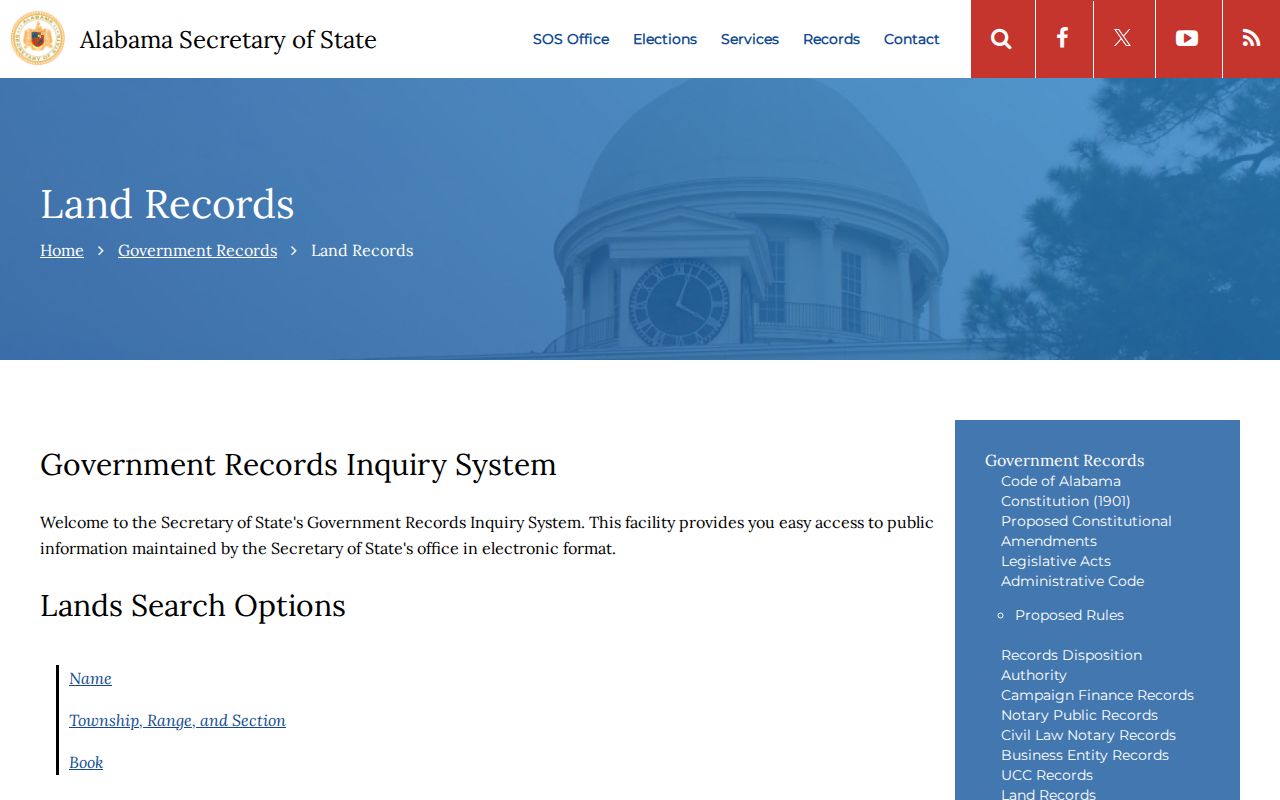
Every result must be matched to the legal description. Only then does it enter the chain. Treat the state system as a complementary collection rather than a guarantee of continuity. Instruments recorded after 1950 belong on the county Probate route. An early state entry may also precede later private conveyances of the same Crenshaw County parcel. Fit each find into the backward sequence rather than assuming it completes the story.
The 1898 Fire Complicates Crenshaw County Ownership History
Crenshaw County formed on November 24, 1866. The seat moved from Rutledge to Luverne in 1893. A courthouse fire struck in 1898. The county publishes no official list identifying every volume the fire affected. An index gap never proves an instrument failed to exist. So the fire should not become an excuse to claim all early Crenshaw County deeds vanished. Pre-1866 research may point to Butler, Coffee, Covington, Pike, or Lowndes County. It depends on the tract. Follow the legal description and the boundary history instead of searching every parent county at random. A pre-1893 document may also name Rutledge even though county offices now sit in Luverne.
ADAH and FamilySearch Extend the Crenshaw County Trail
ADAH holds varying county microfilm. It also holds 1936 WPA township maps that work well as historical locators. FamilySearch catalogs Crenshaw probate records from roughly 1870 to 1930. Film and image access can vary, so confirm before planning a trip. ADAH handles research requests for $15 within Alabama and $25 out of state. Each request covers up to 20 pages. Extra pages run $0.25. The estimated turnaround is two to three weeks.
Probate Events Can Interrupt a Simple Former-Owner Sequence
Not every ownership change comes from a sale. Deaths, survivorship, estate distribution, corrections, judgments, and partitions can all transfer land without an ordinary deed. Search the related probate file. Then locate the recorded instrument or judgment tied to the legal description. Pre-1936 marriage records route to Probate. Divorce evidence before 1950 sits with the Circuit Court. Those events matter only when they connect to the land transfer. The Circuit Clerk keeps electronically imaged Circuit and District Court records. The address is 29 S Glenwood Avenue, Suite 206, Luverne. Just One Look is paid access. Office copies or certifications require a clerk request. A court docket entry is no substitute for the separately recorded deed, lis pendens, or judgment.
Offline Routes for Crenshaw County Previous Owners
Visit Probate at 29 S Glenwood Avenue, Luverne, or call 334-335-6568 and ask for the recording desk. A mail request should list every known grantor and grantee spelling, the date range, book and page, parcel number, full legal description, record type, and certification need. Ask about fees too. The county publishes no posted deed-copy schedule. Alabama public-record procedures appear in Code §§36-12-40 through 36-12-47. A focused request names the custodian, the record, the date span, the preferred format, and a cost ceiling. If the office redirects you to INGRecords, confirm the product, coverage, image quality, payment recipient, and whether certified copies are available; INGRecords is a private service, not a universal state database. Archival fallbacks include ADAH County Records on Microfilm, a research-room or request route, and FamilySearch catalog access that varies by film or affiliate location. For a single deed see Deed Records. For today's record use Current Owner.
Keep a Crenshaw Ownership-History Ledger
Build a ledger with one row per conveyance. For each deed, record the execution date and the recording date separately. Along with those, log grantor, grantee, instrument type, book and page or instrument number, and the full legal description. Capture every prior reference the deed recites. Add rows for plats, mortgages, releases, probate deeds, easements, and court instruments. These often explain a gap in the chain.
A shared surname proves nothing. One person may have owned several parcels. A single deed may convey only part of an interest. Compare the tract language at every step. Keep spouse names, middle initials, estate labels, trust and LLC names, and spelling variants intact. When the legal description shifts, check whether a subdivision, split, combination, correction deed, or boundary instrument accounts for the change.
Tax history can only estimate when an owner label turned over. The web tax system covers 2013 through 2025 plus an All Years view. One account can hold several property rows. Mine those results for parcel and legal clues. Then prove every link with a recorded instrument rather than stopping at the tax roll.
Log negative results with the source, date span, spelling, party role, and portal status. A missing web hit means little when exact recording coverage is unverified or GIS is unavailable. Treat a documented gap as a prompt, not a dead end. Probate books, ADAH microfilm, FamilySearch film, state land records, or the correct parent county may still close it.
How Far Back Crenshaw County Ownership Records Go
The county's online index has no verified start year. The state system runs through 1950. FamilySearch catalogs probate material from roughly 1870 to 1930. Local books or ADAH microfilm can stretch a specific chain further. The 1936 WPA map can place an owner or township historically. It is not title or survey evidence, though. State plainly where documented continuity ends, which years were searched, and which repositories could not be reached.
A sound chain log captures every searched name variation and the role searched. Add the date span, document type, book and page, instrument date, recording date, and exact description. Record negative searches as limited observations. They never prove a prior owner or transfer failed to exist.
Spelling drifts across handwritten indexes and later databases. Search initials, reversed name order, spouses, estate captions, and business variants only when the known chain supports them. Confirm each match by land description and dates. Historical plats often explain a shift from acreage or township language to subdivision, lot, and block references. Ask Probate for the cited plat and compare it against the deed that first uses the new description.
If acreage differs among GIS, a deed, and a survey, keep each figure separate with its source. Also separate the date an instrument was signed from the date it was recorded. A reconstructed timeline should simply reproduce what each record states. It should not decide priority, legal effect, or marketable title.
When a courthouse book or film is unavailable, document the repository, the series requested, the years, and the response. Then continue through the proper county book. The Alabama state land search, ADAH microfilm, the FamilySearch catalog, or a parent-county lead can each carry the chain. That disciplined fallback beats treating one portal's empty result as the end of the former-owner chain.
Lawful use. Former-owner research supports house history, estates, and property diligence. Never use it to track, stalk, harass, or harm a living person.